


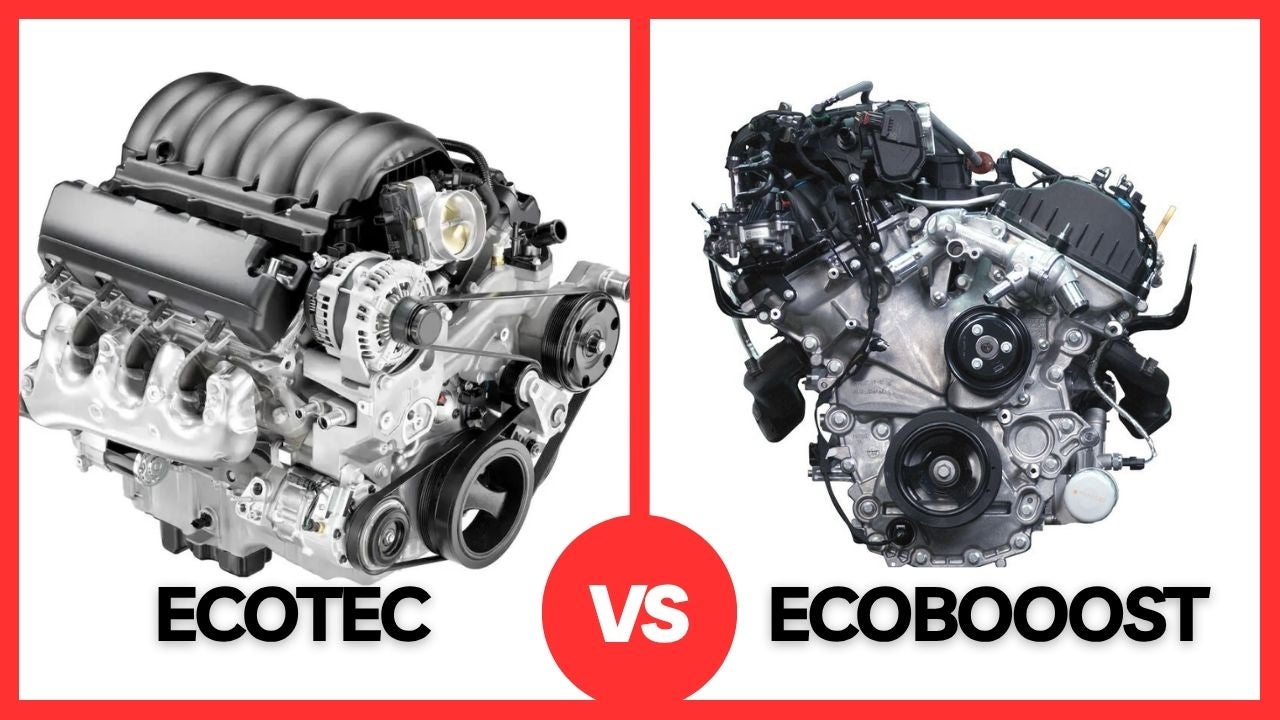
Chevy EcoTec vs. Ford EcoBoost: Chevrolet's EcoTec engines and Ford's EcoBoost engines are both turbocharged, direct-injected powerplants built to squeeze more performance out of a smaller footprint, but they take different paths to get there. EcoTec favors compact, efficient three- and four-cylinder designs across the Chevy Trax, Trailblazer, Equinox and Malibu, while EcoBoost spans a wider range of displacements used in everything from Ford's crossovers to its full-size trucks. Below, we compare the power, technology and fuel economy of each lineup so you can decide which platform fits your driving needs, and the team at Northcutt Chevrolet is happy to help you find the right vehicle to match. If you have been cross-shopping a Chevy against a Ford, chances are you have run into these two engine names. Both automakers built their small-displacement turbo lineups around the same basic idea: use a turbocharger and direct fuel injection to get more power and torque out of a lighter, more efficient engine, so you are not stuck choosing between performance and fuel economy. Where they differ is in the details, from displacement and cylinder count to how each engine is tuned for its specific vehicle. Below, the team at Northcutt Chevrolet puts the two lineups side by side, using the current specifications for the engines you will actually find under the hood of a new Chevy or Ford today. Browse Our New Chevy Inventory What Is the Chevy EcoTec Engine Family? EcoTec is Chevrolet's name for its lineup of turbocharged, direct-injection three- and four-cylinder engines. Every EcoTec engine in our current lineup uses Spark Ignition Direct Injection (SIDI), a dual overhead camshaft (DOHC) design, continuously variable valve timing and automatic stop and start technology, and every one of them runs on regular 87 octane fuel. That combination is designed to deliver strong low-end torque and steady real-world fuel economy without asking you to pay for premium gas at the pump. The EcoTec name currently covers three engines in our showroom: a 1.2-liter turbocharged three-cylinder that is the exclusive engine in the Chevy Trax, a 1.3-liter turbocharged three-cylinder available in the Chevy Trailblazer, and a 1.5-liter turbocharged four-cylinder used in both the Chevy Equinox and the Chevy Malibu. What Is the Ford EcoBoost Engine Family? Ford's EcoBoost family covers a much broader range than EcoTec, spanning three-, four- and six-cylinder turbocharged engines from 1.0 liters up to 3.5 liters. That range lets Ford use the same basic EcoBoost technology, turbocharging, direct injection and Twin Independent Variable Camshaft Timing (Ti-VCT), in everything from the compact Escape and Bronco Sport up through the Explorer, Bronco, Ranger, F-150 and Expedition. For the comparison at hand, the EcoBoost engines closest to Chevy's EcoTec lineup are the 1.5-liter turbocharged three-cylinder found in the Escape and Bronco Sport, the 2.0-liter turbocharged four-cylinder offered on higher trims like the Bronco Sport Badlands, and the 2.3-liter turbocharged four-cylinder used in the Ranger, Bronco, Explorer and Mustang. EcoTec vs. EcoBoost: Power and Performance Compared Here is how the most comparable engines in each lineup stack up on paper. Engine Displacement Horsepower Torque Representative Model Chevy EcoTec Turbo I3 1.2L 137 hp 162 lb-ft Trax Chevy EcoTec Turbo I3 1.3L 155 hp 174 lb-ft Trailblazer Chevy EcoTec Turbo I4 1.5L 175 hp 203 lb-ft Equinox / Malibu Ford EcoBoost Turbo I3 1.5L 180 hp 199 lb-ft Escape Ford EcoBoost Turbo I4 2.3L 270 hp 310 lb-ft Ranger Ford EcoBoost Turbo I4 2.3L 315 hp 350 lb-ft Mustang The numbers show the two philosophies. EcoTec keeps horsepower and torque figures modest but consistent, and every EcoTec engine runs on regular fuel. EcoBoost's smallest engines land in a similar range, but the lineup climbs quickly once you move into the 2.3-liter engine, which trades some of that low-end simplicity for meaningfully more horsepower and torque in vehicles like the Mustang and Ranger. Turbocharging, Injection and Other Technology Differences Both EcoTec and EcoBoost lean on the same core formula: a turbocharger to pressurize incoming air, direct fuel injection to place fuel precisely in the combustion chamber, and variable valve timing to balance power and efficiency as you drive. Where the two families diverge is in the extra technology layered on top. Ford's 1.5-liter EcoBoost combines direct injection with port fuel injection and adds cylinder deactivation, shutting down cylinders when full power is not needed, to help close the efficiency gap. Every current EcoTec engine sticks with a simpler SIDI-only setup paired with automatic stop and start. One naming note worth clearing up: EcoTec should not be confused with EcoTec3, which is the name Chevrolet uses for its V6 and V8 engines in the Silverado and Tahoe. If you want to see our full lineup of gas and diesel engine options, or you are cross-shopping trucks specifically, take a look at how the Silverado stacks up against the F-150. Fuel Economy and Efficiency Fuel economy is where EcoTec's smaller displacement engines tend to shine in city driving. The 1.2-liter EcoTec in the Chevy Trax is rated up to 28 mpg city and 32 mpg highway, and the 1.3-liter EcoTec in the front-wheel-drive Trailblazer is rated up to 29 mpg city and 31 mpg highway. Ford's 1.5-liter EcoBoost in the Escape is rated up to 27 mpg city and 34 mpg highway in front-wheel drive, giving EcoBoost a highway mpg edge in that comparison while EcoTec holds a slight advantage around town. Because every current EcoTec engine runs on regular 87 octane fuel, the cost of fueling up stays consistent no matter which Chevy model you choose. Some higher-output EcoBoost applications, like the 2.3-liter in the Mustang, are tuned to make the most power on premium fuel, which is worth factoring into your long-term cost of ownership. Which Northcutt Chevrolet Models Use the EcoTec Engine? If you like what you see from the EcoTec lineup, here is where you will find each engine in our current inventory: Chevy Trax – powered exclusively by the 1.2-liter turbocharged EcoTec engine Chevy Trailblazer – available with the 1.3-liter turbocharged EcoTec engine, including flex-fuel capability on select trims Chevy Equinox – equipped with the 1.5-liter turbocharged EcoTec engine Chevy Malibu – also equipped with the 1.5-liter turbocharged EcoTec engine Our new inventory changes regularly, and our current new vehicle specials can make the switch even more affordable, so the best way to see current pricing and availability is to browse our new inventory online or give us a call at (800) 997-0790 and we will help you find the EcoTec-powered Chevy that fits your budget. Choosing the Right Engine for Your Driving Needs There is no single right answer between EcoTec and EcoBoost. It comes down to what you drive and how you drive it. If low-end torque, regular-fuel savings and a lower price point matter most, the Trax's 1.2-liter EcoTec or the Trailblazer's 1.3-liter EcoTec are hard to beat. If you want more cabin room without giving up efficiency, the Equinox and Malibu's 1.5-liter EcoTec strikes a good balance. If you are cross-shopping Ford and want more horsepower for towing light loads or highway passing, EcoBoost's 2.0-liter and 2.3-liter options offer more muscle, at the cost of using more fuel and, in some trims, needing premium gas. If a pre-owned option fits your budget better, our used inventory also includes EcoTec-equipped models already on our lot. Whichever direction you lean, our team can walk you through financing options, help you get pre-qualified, run the numbers on our payment calculator, or get you a value your trade estimate on your current vehicle before you decide. Stop by our showroom during our hours or call (800) 997-0790 to schedule a test drive and feel the difference between EcoTec and EcoBoost for yourself. Shop New EcoTec-Powered Chevrolets FAQ Is the Chevy EcoTec engine reliable? Yes. EcoTec engines use a straightforward design, direct injection, a single turbocharger and standard maintenance intervals, and every current EcoTec engine is built to run on regular 87 octane fuel. Staying current on oil changes and other routine maintenance through our service center, including scheduling a service appointment when it is due, is the biggest factor in keeping any EcoTec engine running well for the long haul. What is the difference between EcoTec and EcoTec3? EcoTec refers to Chevrolet's turbocharged three- and four-cylinder engines used in models like the Trax, Trailblazer, Equinox and Malibu. EcoTec3 is a separate engine family, Chevrolet's naturally aspirated V6 and V8 engines used in trucks and full-size SUVs like the Silverado and Tahoe. The names are similar, but the engines are built for very different jobs. Does the Ford EcoBoost engine require premium gas? It depends on the engine. Ford's smaller EcoBoost engines, like the 1.5-liter in the Escape, are designed to run on regular fuel. Higher-output versions, such as the 2.3-liter EcoBoost in the Mustang, are tuned to deliver their peak horsepower and torque on premium fuel, so check the specific engine and trim before you budget for fuel costs. Which is more fuel-efficient, EcoTec or EcoBoost? It is close, and it depends on the specific engines you are comparing. Chevy's smaller EcoTec engines tend to hold a slight edge in city driving, while some EcoBoost engines post a higher highway mpg rating. Because every EcoTec engine runs on regular fuel, EcoTec can still come out ahead on overall fuel cost even when the mpg numbers are similar. What Chevy models with the EcoTec engine does Northcutt Chevrolet have in stock? Our new inventory includes the EcoTec-powered Trax, Trailblazer, Equinox and Malibu, and availability changes regularly. Call us at (800) 997-0790, contact us online, or browse our new inventory to see what is currently on our lot. Find Your Next Chevy at Northcutt

Do Dealerships Buy Cars Even if the Current Loan Hasn't Been Paid Off?
Trading In a Financed Vehicle: Yes, dealerships buy cars and accept trade-ins on vehicles that still carry an outstanding loan. The dealership requests a payoff quote from your lender, sends that balance directly to the lender, and then applies whatever equity is left toward your next vehicle or folds any shortfall into the new financing. Northcutt Chevrolet handles the payoff and lien paperwork for drivers across the Enid area, so an unpaid balance does not have to keep you in a vehicle that no longer fits your life. Almost every driver who pulls onto our lot with a trade-in is still making payments on it. That is completely normal, and it is not an obstacle. A remaining balance simply means your lender holds a lien on the title, and clearing that lien is a routine piece of paperwork we complete at Northcutt Chevrolet nearly every day of the week. The real question is never whether we can buy a financed vehicle. It is how your payoff amount compares to what your vehicle is actually worth, because that one comparison decides whether your trade puts money down on your next Chevy or adds to the amount you finance. Below, we walk through the full process, the paperwork you need, and both of the scenarios you are likely to land in. Value Your Trade Can a Dealership Buy a Car That Still Has a Loan on It? Yes. When you finance a vehicle, your lender records a lien against the title, which means the lender has a legal interest in the car until the balance is satisfied. That lien does not prevent a sale or a trade. It only means the loan has to be paid off as part of the transaction before clear title can change hands. This is one of the clearest advantages of working with a franchise dealership instead of selling to a private party. A private buyer has to coordinate directly with a lender they have no relationship with, often at a bank branch, and many buyers simply walk away rather than deal with the complication. We work with auto lenders constantly, we know how to request a payoff, and we take on that administrative work ourselves. The first step is always the same: we need to know what your vehicle is worth today. You can get that number started before you ever leave the house by using our online tool to value your trade, then bring the vehicle in so we can confirm the appraisal in person. How Does a Car Dealership Pay Off Your Current Loan? The mechanics are more straightforward than most shoppers expect. Here is the sequence we follow on a financed trade-in: We appraise your vehicle and give you a firm written offer based on its year, mileage, condition, options and current market demand. We request a payoff quote from your lender, which is the exact dollar amount required to satisfy the loan. Most lenders issue a ten-day payoff that stays valid through that window so the figure does not shift mid-deal. We compare the payoff quote to your appraised value to determine whether you have equity or a shortfall. We structure the deal, send payment directly to your lender, and the lender releases its lien on the title. Any equity above the payoff is credited to your purchase as a down payment, or returned to you if you are simply selling the vehicle. What About Payments You Make During the Transition? Payoff checks are typically mailed or wired within a few business days of delivery, and lenders usually post them within one to two weeks. If a scheduled payment comes out of your account before the payoff posts, or if interest accrued between the quote date and the posting date works in your favor, your lender refunds the overage directly to you. We always recommend letting any automatic payment run as scheduled rather than canceling it early, and then watching for the refund. Positive Equity or Negative Equity: Where Do You Stand? Everything about your deal comes down to the gap between your payoff amount and your appraised value. There are only two outcomes, and both are workable. Positive Equity If your vehicle appraises for more than you owe, the difference belongs to you. A vehicle worth $24,000 with a $17,500 payoff leaves $6,500 in equity, and that money goes straight to work as a down payment on your next vehicle, lowering both the amount financed and the monthly payment. Trucks and SUVs in good condition have held their value well in our market, so a surprising number of Enid drivers are sitting on equity they did not realize they had. Negative Equity If you owe more than the vehicle is worth, you are what the industry calls upside down. This is far more common than most people assume. Edmunds reported that 29.6 percent of trade-ins toward new-vehicle purchases in the second quarter of 2026 carried negative equity, with the average shortfall sitting at $6,884. You are not in unusual territory, and we see it constantly. When there is a shortfall, you have a few paths. You can pay the difference in cash at signing, which keeps your next loan clean. You can roll the remaining balance into the new financing, which is simple but increases the amount you borrow and the interest you pay over the term. Or you can wait, keep paying down the current loan, and revisit the trade once the gap narrows. Our finance team will show you the real numbers on each option instead of steering you toward one. Running the math ahead of time helps. Our payment calculator lets you model different down payments and terms, our finance center explains how we structure deals, and you can get pre-qualified in a few minutes without affecting your credit score. What Do You Need to Bring to Trade In a Financed Vehicle? Gathering a few items before you arrive turns a long afternoon into a short one. Bring the following: Your lender name, loan account number and, if you already have it, a current payoff quote. A valid driver license for every person listed on the loan or the title. Current registration and proof of insurance for the vehicle you are trading. All keys, key fobs and remotes, since missing keys reduce the appraised value. The owner manual, any service records you have kept and any accessories that came with the vehicle. The title itself only if your lender does not hold it, which is uncommon while a loan is active. If anyone else is listed as a co-borrower on the loan, that person needs to be present to sign. Not sure what your lender requires? Contact us with your account details and we will make the call on your behalf before you come in. Should You Sell Outright or Trade Toward Another Vehicle? We buy vehicles outright whether or not you purchase something from us, and a loan balance does not change that. If you are downsizing to one household vehicle or moving out of state, selling outright is a clean exit and we will still handle the payoff and lien release. Most drivers, though, are trading because they want something different. If that is you, it helps to know what is sitting on the lot before you commit to a number. Our new inventory spans the full model lineup, from the compact Chevy Trax to the Chevy Equinox and the Silverado 1500. We also stock electric vehicles for shoppers ready to leave the pump behind. If keeping the payment low is the priority, our pre-owned inventory is usually where equity stretches furthest. We maintain a rotating selection of Carfax 1-Owner vehicles, a strong run of used trucks, and a group of options priced under $25,000. Pairing one of those with current offers is often how an upside-down trade still ends in a lower monthly payment. Call us at (800) 997-0790 and we will tell you what just landed before it hits the website. Prefer to handle the early steps from your couch? You can start your deal online, submit your trade details, and only come in once the numbers are already agreed. Why Start the Payoff Conversation at Northcutt Chevy? Enid drivers have trusted us with their vehicles for a long time, and you can read more about our dealership and the families who have been coming back for generations. What has not changed is how we approach a trade: show the appraisal, show the payoff, show the gap, and let you decide. That transparency is the part our team takes seriously. Nobody here benefits from hiding a shortfall inside a payment, and we would rather tell you to wait six months than put you into a deal that does not hold up. Come see us at our Enid showroom during our hours, or call ahead at (800) 997-0790 so we can have your payoff quote in hand when you arrive. If you want to drive something before you commit, schedule a test drive and we will have it pulled up front and ready. One more thing worth knowing: a trade appraises higher when it has been cared for. If your current vehicle is overdue for maintenance, our service center can bring it current first, and it takes about a minute to schedule service online. Get Your Trade-In Value FAQ Can I trade in a car that is not paid off? Yes. An active loan does not block a trade-in. Your lender holds a lien on the title, and that lien is cleared as part of the transaction when the payoff is sent. The only thing that changes from one deal to the next is whether your appraised value is higher or lower than the payoff amount, which determines whether you bring equity to the table or carry a balance forward. How does a car dealership pay off your current loan? We request a payoff quote from your lender, which states the exact amount needed to satisfy the loan, then send that payment directly to the lender after the deal is signed. The lender releases its lien and the title transfers. You never have to send money to your lender yourself or coordinate the release, because we handle that step as part of the paperwork. What happens if I owe more than my car is worth? You have three realistic options. You can pay the shortfall in cash at signing, roll it into the financing on your next vehicle, or hold off and keep paying down the current loan until the gap closes. Rolling negative equity forward is common and perfectly legitimate, but it does increase what you borrow, so we will show you the total cost of each path before you choose one. Do I need the title to trade in a financed vehicle? Usually not. While a loan is active, the lender typically holds the title or is recorded as the lienholder on an electronic title, so there is nothing for you to bring. What we do need is your lender name, your loan account number and current registration. If you happen to have a paper title in your possession, bring it along with your driver license. How long does it take to find out what my trade is worth? An online estimate takes a couple of minutes, and an in-person appraisal is usually finished in under half an hour. If you want to line up a payoff quote and an appraisal on the same visit, call us at (800) 997-0790 before you head over and we will start the lender request in advance. We can also tell you which vehicles are currently in stock so you are not shopping blind. Start Your Trade-In Appraisal